
Year 5 Maths Curriculum: A Comprehensive Overview
Year 5 maths builds upon prior knowledge, extending understanding of the number system and place value, alongside mastering multi-step problem-solving techniques.
Year 5 marks a pivotal stage in primary mathematics, consolidating foundational skills while introducing more complex concepts. Pupils refine their arithmetic abilities, tackling larger numbers and multi-step problems with increasing confidence. The curriculum emphasizes both procedural fluency and conceptual understanding, ensuring children can not only do maths, but also understand why methods work.
Key areas include place value extending to five and six-digit numbers, formal written methods for all four operations, and a deeper exploration of fractions, decimals, and percentages. Pupils also begin to encounter negative numbers and geometrical properties of shapes, preparing them for the challenges of upper Key Stage 2.
Number and Place Value
Year 5 builds upon previous place value knowledge, focusing on understanding and working with numbers up to six digits. Pupils will confidently read, write, order, and compare these larger numbers. A key element involves recognizing the value of each digit and partitioning numbers in various ways.
Furthermore, the curriculum introduces reading and writing numbers in Roman numerals up to 1000 (M), connecting mathematical history with current understanding. This foundational work is crucial for all subsequent mathematical concepts.
Understanding 5- and 6-Digit Numbers
Year 5 students deepen their understanding of place value by working extensively with 5- and 6-digit numbers. They learn to recognize, model, read, write, and order these numbers accurately. This includes partitioning numbers into thousands, hundreds, tens, and units, and understanding the zero as a placeholder.
Pupils practice comparing and ordering numbers using greater than (>), less than (<), and equal to (=) symbols, solidifying their numerical sense and preparing them for more complex operations.
Reading and Writing Numbers in Roman Numerals (up to 1000)
Year 5 introduces pupils to the fascinating world of Roman numerals, focusing on reading and writing numbers up to 1000 (M). They learn to recognize the symbols I, V, X, L, C, D, and M, and understand their corresponding values.
Students practice converting between Roman numerals and standard numbers, recognizing patterns and applying rules to accurately represent numbers within the specified range, often relating this to historical years.
Addition and Subtraction
Year 5 builds upon existing addition and subtraction skills, focusing on formal written methods to tackle more complex problems. Pupils refine their ability to add and subtract whole numbers with increasing digits, including multi-step problems requiring multiple operations.
Emphasis is placed on applying these skills to real-life scenarios, developing problem-solving strategies and ensuring accuracy through checking and reasoning.
Formal Written Methods for Addition and Subtraction
Year 5 pupils consolidate and refine formal written methods for both addition and subtraction. This includes mastering column addition and subtraction, with a focus on accurately aligning digits based on place value. They will practice adding and subtracting numbers with up to four digits,
including those involving exchanging between columns (regrouping/borrowing) to ensure precise calculations and a strong conceptual understanding of the processes.
Solving Multi-Step Addition and Subtraction Problems
Year 5 students progress to tackling multi-step addition and subtraction problems, requiring them to identify the necessary operations and their order. These problems often involve a combination of adding and subtracting, demanding careful analysis and planning. Pupils learn to apply their understanding of formal written methods
to solve these more complex scenarios, demonstrating mathematical reasoning and accuracy in their calculations, and interpreting the results within the context of the problem.
Multiplication and Division
Year 5 focuses on consolidating multiplication and division skills, introducing more efficient methods. Pupils refine their understanding of short multiplication and short division techniques, applying them to solve a wider range of problems. A key focus is dividing numbers up to four digits by a single-digit number,
interpreting any remainders appropriately. This builds a strong foundation for more complex calculations encountered in later years, emphasizing fluency and accuracy in these fundamental operations.
Short Multiplication and Short Division Methods
Year 5 pupils build proficiency in short multiplication, multiplying numbers up to three digits by a single digit. Simultaneously, they master short division, dividing numbers – including those with remainders – by a single digit. These methods are presented as formal written procedures,
emphasizing a clear and structured approach to calculation. Consistent practice ensures fluency and accuracy, preparing students for tackling more complex division problems later in their mathematical journey.
Dividing Numbers up to 4 Digits by a One-Digit Number
Year 5 students learn to divide numbers reaching four digits by a single digit, utilizing the formal written method of short division. A key focus is interpreting remainders appropriately within the context of the problem – understanding what the remainder represents in real-world scenarios.
This skill builds upon prior division knowledge, fostering a deeper understanding of division as sharing and grouping, and preparing them for more advanced mathematical concepts.
Fractions (Including Decimals and Percentages)
Year 5 maths introduces a deeper exploration of fractions, encompassing equivalent fractions – recognizing different ways to represent the same value. Pupils will practice adding and subtracting fractions that share a common denominator, solidifying their understanding of fractional parts.
This foundational work prepares students for understanding the relationship between fractions, decimals, and percentages, building a comprehensive grasp of numerical representation.
Equivalent Fractions
Year 5 pupils learn to identify and create equivalent fractions, understanding that multiple fractions can represent the same amount. This involves finding fractions that have different numerators and denominators but hold the same value, like 1/2 and 2/4.
They’ll explore how multiplying or dividing both the numerator and denominator by the same number generates equivalent forms, crucial for later fraction operations.

Adding and Subtracting Fractions with the Same Denominator

Year 5 students will confidently add and subtract fractions that share a common denominator. They learn that when denominators are identical, only the numerators are calculated – added together for addition, or subtracted for subtraction – while the denominator remains unchanged.
This foundational skill prepares them for working with fractions possessing differing denominators in subsequent learning stages.
Decimal Fractions
Year 5 introduces decimal fractions, building upon the understanding of place value. Pupils explore how decimals represent parts of a whole, extending beyond whole numbers. They’ll learn to understand decimal place value, recognizing tenths and hundredths, and how these relate to fractions.
This knowledge forms a crucial bridge between fractions and decimal representation, enhancing numerical fluency.
Understanding Decimal Place Value
Year 5 pupils delve into understanding decimal place value, recognizing that digits after the decimal point represent fractions. They learn tenths are one-tenth, and hundredths are one-hundredth of a whole. This involves identifying the value of each digit in a decimal number, like 3.45, where 4 represents four-tenths and 5 represents five-hundredths.
This foundational skill is vital for future decimal operations.
Converting Between Fractions and Decimals
Year 5 students begin converting between fractions and decimals, understanding their interconnectedness. They learn that fractions can be expressed as decimals by dividing the numerator by the denominator – for example, 1/2 equals 0.5. Conversely, decimals like 0.75 can be represented as fractions (3/4).
This skill reinforces number sense and prepares them for more complex calculations.
Negative Numbers
Year 5 introduces the concept of negative numbers, extending the number line beyond zero. Pupils learn to identify and use negative numbers in context, such as temperatures below zero or representing debts. They begin to understand that negative numbers are the opposite of positive numbers,
and explore simple calculations involving both.
Year 5 pupils embark on understanding numbers below zero, extending the number line. This involves recognizing negative numbers as representing quantities opposite to positive values. They’ll explore real-life scenarios like temperatures falling below freezing or financial debts, providing context for these abstract concepts.
Initial focus is on identification and representation.
Using Negative Numbers in Context
Year 5 students apply negative numbers to practical situations, solidifying their understanding beyond abstract representation. This includes interpreting temperature scales showing below-zero values, tracking changes in bank accounts with withdrawals represented as negative amounts, and understanding sea levels relative to a baseline.
Problem-solving emphasizes real-world relevance.
Geometry: Properties of Shapes
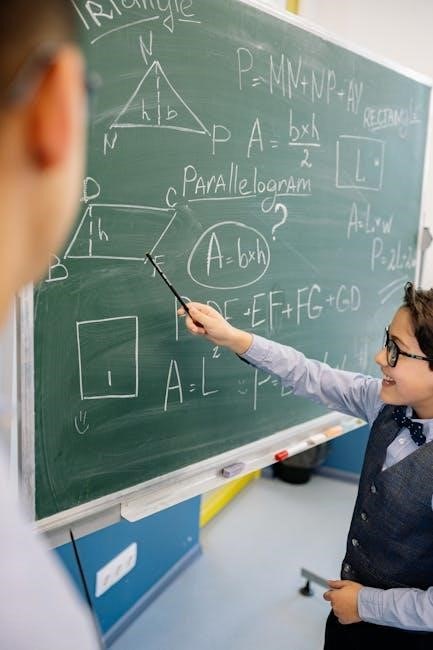
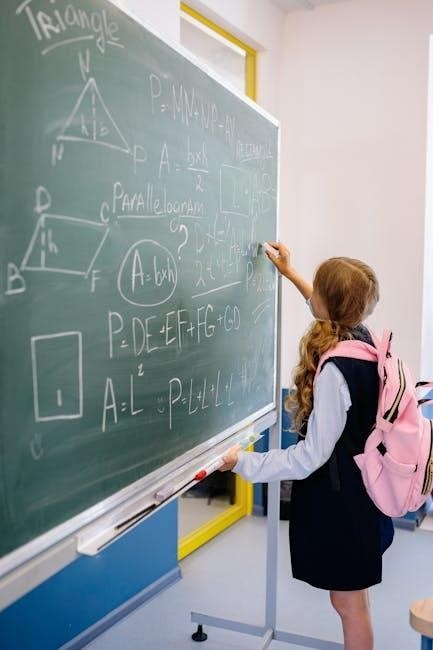
Year 5 geometry focuses on identifying and classifying 2D shapes, including regular polygons, and understanding their properties like sides and angles. Pupils learn to measure angles accurately using protractors, recognizing acute, obtuse, and right angles within shapes.
This builds a foundation for future geometric concepts and spatial reasoning skills.

Identifying and Classifying 2D Shapes
Year 5 students will confidently identify and classify various 2D shapes, including squares, rectangles, triangles, and polygons; They’ll learn to recognize regular and irregular shapes, understanding the characteristics that define each category.
Pupils will explore properties like the number of sides and angles, developing a strong geometric vocabulary and spatial awareness crucial for problem-solving;
Measuring Angles
In Year 5, pupils will learn to measure angles in degrees using protractors accurately. They’ll identify acute, obtuse, and right angles, understanding their relative sizes and how they fit within larger shapes.

Students will also explore angles on a straight line and around a point, applying this knowledge to solve geometric problems and develop a deeper understanding of spatial relationships.
Measurement
Year 5 measurement focuses on converting between different units of length, mass, and volume. Pupils will confidently convert kilometers to meters, grams to kilograms, and liters to milliliters, applying these skills in practical contexts.
Furthermore, they’ll calculate the perimeter and area of rectangles and squares, understanding these concepts and using formulas to solve related problems, reinforcing their geometric understanding.
Converting Units of Measurement (Length, Mass, Volume)
Year 5 pupils will expertly convert between metric units – kilometers and meters, centimeters and millimeters, grams and kilograms, milliliters and liters. They’ll apply conversion factors to solve real-world problems, demonstrating a strong grasp of proportional reasoning.
Understanding these conversions is crucial for practical applications, enabling accurate measurements and calculations in various contexts, solidifying their mathematical fluency.
Calculating Perimeter and Area
Year 5 students will confidently calculate the perimeter of various shapes, including rectangles and irregular polygons, applying their addition skills. They’ll also learn to determine the area of rectangles and squares, utilizing multiplication to find the space enclosed within.
This builds a foundation for understanding more complex geometric concepts and real-world applications like flooring or fencing.
Statistics
Year 5 pupils develop skills in interpreting and presenting data using various charts and graphs, like bar charts and line graphs. They learn to extract meaningful information from these visual representations, answering questions and identifying trends.
Understanding scales, axes, and data points is crucial, fostering analytical thinking and the ability to draw conclusions from statistical information.
Interpreting and Presenting Data (Charts, Graphs)
Year 5 students learn to interpret data presented in charts, including bar charts, line graphs, and pictograms. They practice reading scales, identifying key information, and answering questions based on the data displayed.
Furthermore, they gain experience in presenting data themselves, choosing appropriate chart types and accurately representing information visually, developing crucial analytical skills.
Problem Solving and Reasoning
Year 5 maths heavily emphasizes applying mathematical skills to real-life scenarios, fostering practical understanding. Pupils tackle multi-step problems, requiring them to identify relevant information and select appropriate strategies.
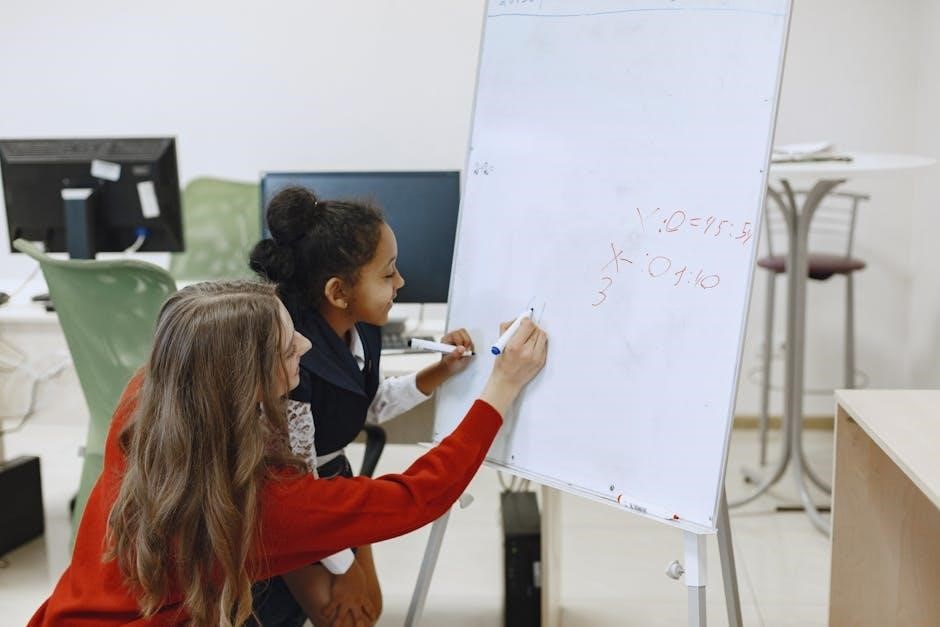
Developing logical thinking and justification is key; children must explain their reasoning and demonstrate their understanding of mathematical concepts, building confidence and analytical abilities.
Applying Mathematical Skills to Real-Life Scenarios
Year 5 pupils encounter problems mirroring everyday situations, like calculating costs with decimals during shopping trips or measuring ingredients for baking – bridging the gap between theory and practice.
These scenarios demand pupils to select appropriate operations, interpret data, and justify their solutions, strengthening their ability to utilize maths functionally.
Developing Logical Thinking and Justification
Year 5 focuses on cultivating reasoning skills, prompting pupils to explain their mathematical choices and demonstrate understanding beyond simply arriving at a correct answer.
They learn to articulate strategies, identify patterns, and construct logical arguments to support their solutions, fostering a deeper comprehension of mathematical principles and enhancing problem-solving abilities.