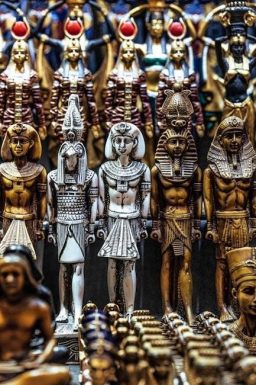
Ancient Egyptian symbolism, a rich tapestry of imagery, profoundly influenced their art, religion, and daily life. These symbols, often found in hieroglyphs, conveyed complex ideas.
Historical Context of Egyptian Symbolism
Egyptian symbolism evolved over millennia, beginning in the pre-dynastic period (before 3100 BCE) with rudimentary depictions. Early symbols likely originated in rival royal courts, predating unified Egypt. The development of hieroglyphic writing, around the late fourth millennium BC, was crucial, transforming pictorial representations into a sophisticated system.
Throughout the Old, Middle, and New Kingdoms, symbolism became increasingly codified and integrated into religious beliefs, funerary practices, and royal ideology. The meanings of symbols weren’t static; they shifted and gained layers of interpretation over time. By the Ptolemaic and Roman periods, some symbols experienced decline or adaptation, yet their core essence remained influential, preserved through texts and artistic traditions. Understanding this historical trajectory is vital for deciphering their significance.
The Importance of Symbolism in Ancient Egypt
Symbolism permeated every facet of ancient Egyptian life, functioning as a primary mode of communication and a cornerstone of their worldview. It wasn’t merely decorative; it embodied fundamental beliefs about creation, the afterlife, and the divine order – Ma’at. Symbols conveyed complex religious concepts inaccessible through literal representation.
For the educated elite, these images weren’t random; they were laden with meaning, representing categories of universal significance and higher values. Symbols reinforced social hierarchies, legitimized royal power, and ensured cosmic balance. From temple carvings to personal amulets, symbolism offered protection, invoked divine favor, and facilitated the journey to the afterlife. Deciphering these symbols unlocks a deeper understanding of Egyptian culture.
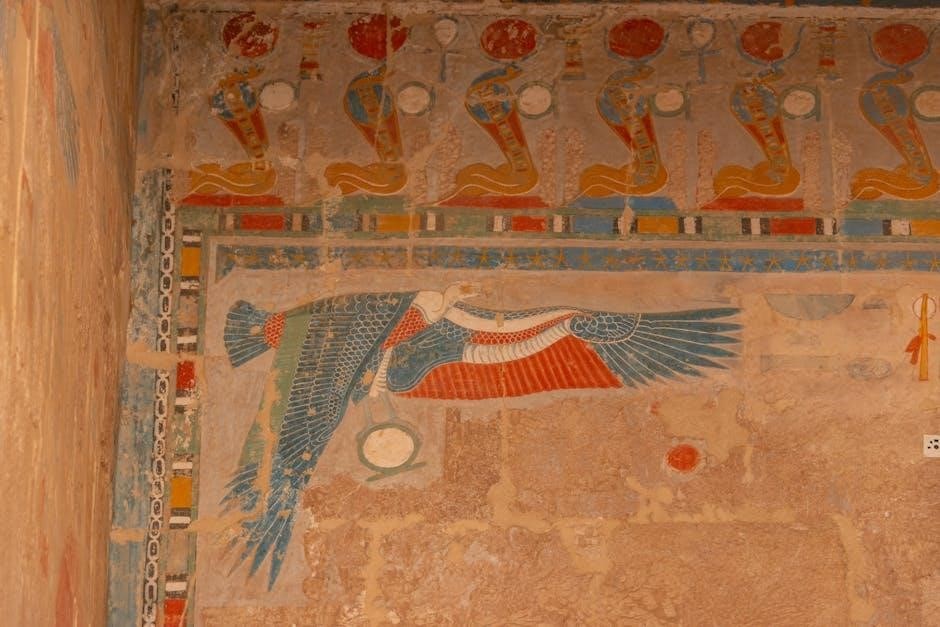
Key Egyptian Symbols and Their Meanings
Iconic emblems like the Ankh, Scarab, and Eye of Horus held profound significance, representing life, rebirth, and protection within Egyptian belief systems.

The Ankh: Symbol of Life
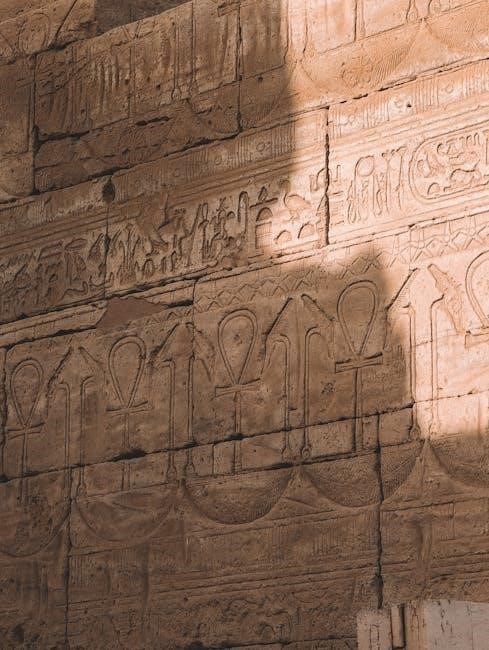
The Ankh, arguably the most recognizable Egyptian symbol, represents life itself – eternal life, specifically. Often depicted in the hands of deities or offered to pharaohs, it signified the gift of breath and continued existence. Its looped shape is theorized to represent the sun’s movement across the sky, or the union of male and female principles.
Beyond physical life, the Ankh embodied immortality and the afterlife, frequently appearing in funerary art and spells. It wasn’t merely a symbol of existence, but a potent amulet offering protection and ensuring a successful transition to the next world. The Ankh’s enduring presence in Egyptian art demonstrates its central role in their worldview, a constant reminder of life’s preciousness and the promise of eternity.
The Scarab Beetle: Rebirth and Transformation
The Scarab Beetle (Scarabaeus sacer) held immense significance for the ancient Egyptians, embodying themes of rebirth, renewal, and transformation. Observing the beetle rolling dung balls across the ground, they likened this action to the sun god Ra pushing the sun across the sky each day.
Consequently, the scarab became a powerful symbol of creation and resurrection. Amulets shaped like scarabs were incredibly popular, often inscribed with spells for protection and ensuring rebirth in the afterlife. These amulets were frequently placed over the heart of the deceased during mummification. The beetle’s life cycle – emerging fully formed from the dung ball – mirrored the Egyptian belief in overcoming death and achieving eternal life.
The Eye of Horus: Protection, Health, and Restoration
The Eye of Horus, also known as the Wedjat eye, is one of the most recognizable symbols from ancient Egypt, representing protection, royal power, and good health. Originating from the myth of Horus, who lost his eye in a battle with Seth, it was magically restored, symbolizing healing and wholeness.
Egyptians believed the eye possessed potent protective powers, warding off evil and ensuring well-being. Amulets depicting the Eye of Horus were commonly worn by both the living and the dead. Furthermore, the eye’s components were mathematically linked to fractions, used in measuring grain and other commodities, demonstrating its practical application beyond purely religious contexts. It signified restoration and completeness.
The Djed Pillar: Stability and Endurance
The Djed pillar is an ancient Egyptian symbol representing stability, endurance, and permanence. Resembling a column with a broad base and four parallel lines, it is closely associated with the god Osiris, representing his spine. The raising of the Djed pillar was a significant religious ceremony, symbolizing the resurrection of Osiris and the renewal of life and kingship.
This symbol embodied the steadfastness required for maintaining cosmic order (Ma’at). Often depicted in funerary contexts, the Djed pillar ensured the deceased’s stability in the afterlife. It was also a powerful emblem of royal authority, signifying the pharaoh’s role in upholding stability within Egypt. Amulets in the shape of the Djed pillar were worn for protection and strength.
The Was Scepter: Power and Dominion
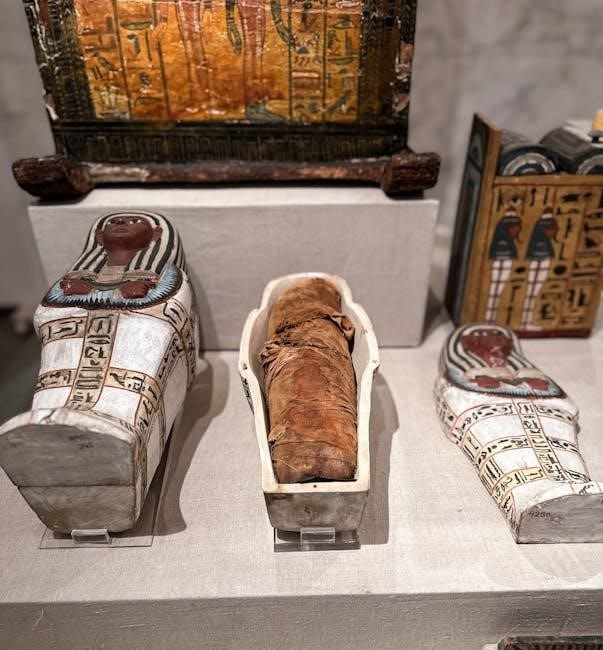
The Was scepter, a distinctive symbol in ancient Egypt, represented power, dominion, and control. Typically depicted as a long staff with a forked base and an animal head – often a canine – it was a potent emblem of authority held by gods, goddesses, and pharaohs. The scepter signified the right to rule and the ability to maintain order within the cosmos.
Frequently seen in the hands of deities like Anubis and Osiris, the Was scepter reinforced their divine authority. For pharaohs, it symbolized their role as the chief administrator and protector of Egypt. The scepter wasn’t merely a symbol of power, but also represented vitality and the ability to overcome chaos. Its presence in artwork and funerary objects underscored the importance of maintaining control in both life and the afterlife.
The Crook and Flail: Kingship and Authority
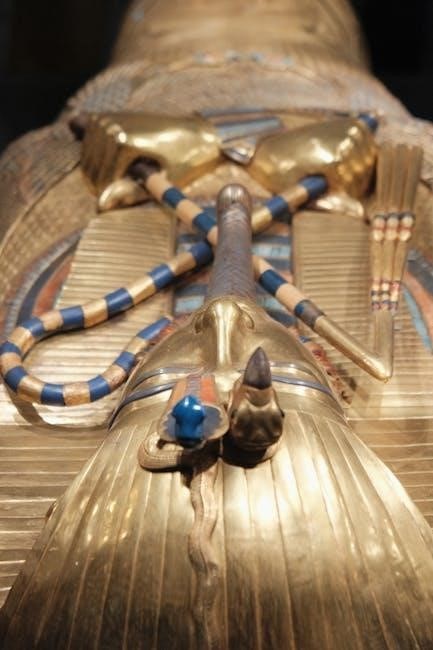
The crook and flail are iconic symbols inextricably linked to ancient Egyptian kingship and authority. The crook, a shepherd’s staff, represented the pharaoh’s role as the protector and shepherd of his people, guiding them and ensuring their well-being. The flail, originally a tool for threshing grain, symbolized the pharaoh’s provision of sustenance and fertility to the land.
Together, these implements signified the pharaoh’s dual role: benevolent leader and provider. They were frequently depicted crossed over the chest of the pharaoh in statues and tomb paintings, demonstrating their power and responsibility. These weren’t simply tools, but potent emblems of rulership, reinforcing the divine mandate of the pharaoh and their connection to the agricultural prosperity of Egypt.
Hieroglyphs: The Sacred Writing
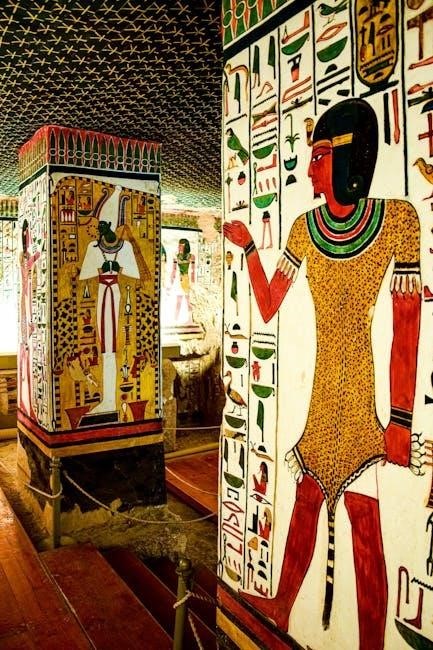
Hieroglyphs, meaning “sacred carvings,” were the formal writing system used in ancient Egypt, combining logograms, phonograms, and determinatives for complex communication.
Understanding Hieroglyphic Script
Hieroglyphic script wasn’t a simple alphabet; it was a sophisticated system blending different types of signs. Logograms represented entire words or morphemes, functioning as ideograms – pictures representing concepts. Phonograms, conversely, represented sounds, similar to letters, but could stand for one, two, or three consonants. Crucially, vowels were generally omitted.
Adding to the complexity were determinatives – signs placed at the end of words to clarify their meaning, indicating the general category to which a word belonged. These weren’t pronounced but aided in interpretation. The direction of reading varied; hieroglyphs could be written horizontally or vertically, and the order was indicated by the direction the animal and human figures faced. Mastering this script required extensive training, making scribes highly valued members of Egyptian society.
Logograms, Phonograms, and Determinatives
The Egyptian writing system ingeniously combined three core elements: logograms, phonograms, and determinatives. Logograms functioned as whole words or morphemes, directly representing an object or idea with a pictorial symbol – a sun disk for ‘Ra’ or ‘sun’. Phonograms, however, represented sounds, acting like phonetic building blocks. A single phonogram could represent one, two, or even three consonants.
To resolve ambiguity, determinatives were added. These silent signs didn’t contribute to pronunciation but clarified a word’s category – a walking legs determinative indicated motion. This tri-partite system allowed for nuanced expression and complex communication, showcasing the Egyptians’ sophisticated linguistic approach. Understanding these components is key to deciphering hieroglyphic texts.
Bilateral Phonetic Values in Hieroglyphs
A fascinating aspect of hieroglyphic writing lies in its frequent use of bilateral phonetic values. Many hieroglyphs didn’t represent single sounds, but rather combinations of two consonants. This system significantly expanded the phonetic repertoire available to scribes, allowing for a greater range of expression and more efficient representation of the Egyptian language.
Documents reveal lists correlating specific hieroglyphs with their corresponding biliteral sounds. For example, a particular symbol might consistently represent the consonant cluster ‘pr’. This wasn’t a rigid rule, as hieroglyphs could also function as uniliteral or logographic signs, adding complexity. Recognizing these bilateral values is crucial for accurate translation and understanding the nuances of ancient Egyptian texts.
Writing Your Name in Hieroglyphs
Translating a modern name into hieroglyphs isn’t a direct, one-to-one substitution. Egyptian hieroglyphs primarily represented sounds, not letters, and relied heavily on phonetic complements. To transcribe a name, one must identify the closest equivalent sounds within the ancient Egyptian language.
This often involves breaking down the name into its constituent sounds and finding hieroglyphs representing those sounds – utilizing uniliteral, biliteral, or triliteral signs. It’s important to remember that the result is a phonetic approximation, not a literal translation. Online resources and guides can assist with this process, offering tables of hieroglyphs and their phonetic values, allowing individuals to explore this fascinating aspect of ancient Egyptian writing.
Egyptian Numerals
Ancient Egyptians employed two numeral systems: hieroglyphic, using distinct symbols for each power of ten, and hieratic, a simplified, cursive form for everyday use.
Hieroglyphic Numerals System
The hieroglyphic numeral system was a base-ten system, meaning it was based on powers of ten. Unique symbols represented each power: a single stroke for one, a heel bone for ten, a coiled rope for one hundred, a lotus flower for one thousand, a bent finger for ten thousand, a burbot fish for one hundred thousand, and a god with raised arms for one million.
These symbols were repeated as needed to represent a quantity. For example, to write thirty, three heel bone symbols would be used. Importantly, the Egyptians did not have a concept of zero as a number; its absence simply indicated an empty place value. This system, while visually complex, allowed for the precise recording of quantities in administrative and religious contexts, often appearing alongside beautiful artistic depictions.
Hieratic Numerals System
Developing alongside hieroglyphs, the hieratic numeral system offered a more cursive and simplified method for representing numbers. Primarily used by priests for religious texts and daily record-keeping, hieratic numerals were quicker to write than their hieroglyphic counterparts. Like the hieroglyphic system, it was also based on powers of ten, employing distinct symbols for 1, 10, 100, and so on.
However, hieratic symbols differed in appearance – often resembling simple strokes or variations of the hieroglyphic forms. A single vertical stroke represented one, a small loop signified ten, and so forth. Similar to hieroglyphs, the Egyptians lacked a symbol for zero in this system, relying on context to indicate empty place values. This streamlined system facilitated efficient administration and documentation.
Symbols of Gods and Goddesses
Egyptian deities were frequently associated with specific animal representations and objects, like feathers for goddesses, embodying their powers and attributes in art.
Feathers and Goddesses: Symbolism in Art
Feathers held significant symbolic weight in ancient Egypt, particularly when associated with goddesses. Representing truth, justice, and divine power, they were closely linked to Ma’at, the goddess of cosmic order, often depicted with an ostrich feather on her head.
This feather was used in the Weighing of the Heart ceremony, determining a soul’s worthiness for the afterlife. Art frequently showcases feathers adorning goddesses like Isis and Hathor, signifying their connection to the heavens and their protective qualities.
The presence of feathers in artwork wasn’t merely decorative; it communicated a deeper spiritual meaning, highlighting the goddess’s role in maintaining balance and harmony. Even composite images, like those featuring feathers alongside other symbols, conveyed layered meanings understood by the educated elite.
Animal Representations of Deities
Animal symbolism was pervasive in ancient Egyptian religion, with numerous deities embodying animal forms or possessing animal heads. These representations weren’t arbitrary; each animal possessed characteristics Egyptians associated with specific divine attributes. For example, the falcon symbolized Horus, representing kingship, protection, and the sky.
The jackal embodied Anubis, linked to mummification and the afterlife, while the cat was sacred to Bastet, goddess of home, fertility, and protection.
Lions represented Sekhmet, a powerful warrior goddess, and crocodiles symbolized Sobek, associated with fertility, military prowess, and the Nile. These animal forms allowed Egyptians to visualize and connect with the deities’ powers and roles within their complex cosmology, enriching their artistic and religious expressions.
Symbolism in Egyptian Art and Architecture
Egyptian art and architecture were deeply symbolic, utilizing carvings and color to convey religious beliefs and royal power, reflecting their worldview.
Symbolic Representations in Carvings
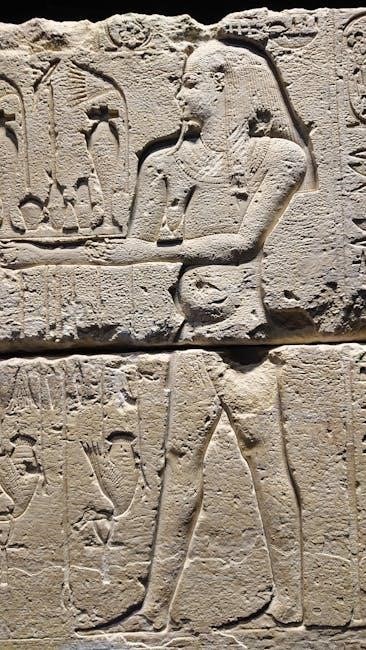
Carvings served as a primary medium for expressing complex Egyptian beliefs and narratives. Images weren’t merely decorative; they were potent symbols communicating religious concepts, historical events, and the pharaoh’s divine authority. A bird, bottle, or lion weren’t random choices, but deliberate representations with layered meanings accessible to the educated elite.
For example, depictions of gods often incorporated animal heads, signifying specific attributes. The careful arrangement of figures and objects within a scene also held symbolic weight, reflecting cosmic order and the relationship between the human and divine realms. These intricate carvings, found on temple walls, tombs, and obelisks, provide invaluable insights into ancient Egyptian thought.
The Use of Color in Symbolism
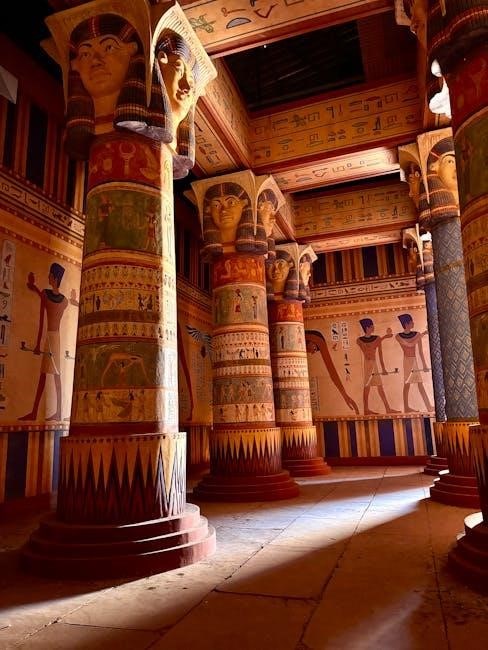
Color played a crucial role in Egyptian symbolism, extending beyond mere aesthetics. Each hue possessed specific meanings deeply rooted in their worldview and religious beliefs. Red, for instance, represented power, vitality, and sometimes, destruction, often associated with the desert and the god Seth. Green symbolized regeneration, fertility, and the life-giving power of the Nile.
Blue was linked to the heavens, water, and creation, while yellow represented the eternal and incorruptible, often used for the flesh of the gods. Black symbolized death and the underworld, but also rebirth and transformation. The consistent and deliberate application of these colors in paintings and carvings reinforced the symbolic narratives and conveyed deeper layers of meaning.
Symbolism in Temple Design
Egyptian temple design was profoundly symbolic, mirroring the cosmos and the journey of the sun god Ra. The layout often replicated the primordial mound, Benben, representing creation. Pylons, massive gateway structures, symbolized the horizon, while the inner sanctuaries housed the god’s statue, considered their earthly dwelling.
Columns, adorned with hieroglyphs and depictions of deities, supported the roof and represented the papyrus reeds of the Nile, symbolizing Lower Egypt. The orientation of temples frequently aligned with astronomical events, like the solstices, reinforcing their connection to the divine order. Every element, from the floor plan to the ceiling decorations, served a symbolic purpose, creating sacred spaces imbued with religious meaning.
The Rosetta Stone and Decipherment
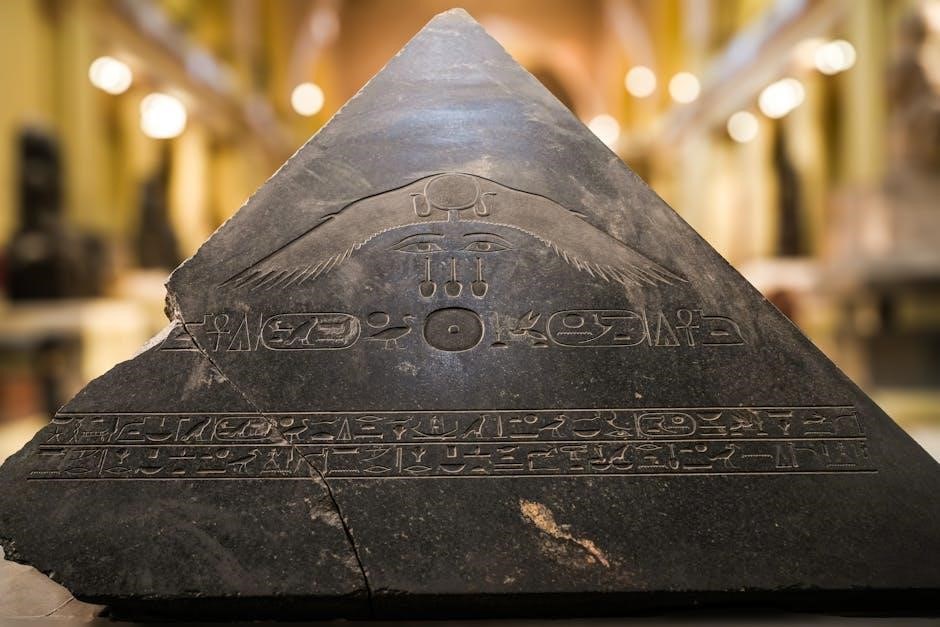
The Rosetta Stone, discovered in 1799, provided the key to deciphering hieroglyphs, featuring the same text in three scripts: Hieroglyphic, Demotic, and Greek.
The Discovery of the Rosetta Stone
The Rosetta Stone’s discovery in 1799 during Napoleon’s Egyptian campaign proved pivotal. French soldiers, rebuilding Fort Julien near the town of Rashid (Rosetta), unearthed the stone. It quickly became apparent this wasn’t just any rock; it bore inscriptions in three scripts – Hieroglyphic, Demotic, and Ancient Greek.
Scholars immediately recognized the potential significance. As the Greek was known, it offered a crucial key to unlocking the previously indecipherable Egyptian scripts. The stone was seized by the British in 1801 after Napoleon’s defeat and transported to the British Museum, where it remains a centerpiece today. This find ignited decades of dedicated research, ultimately leading to the understanding of Egyptian hieroglyphs and, consequently, their rich symbolic language.
Unlocking the Meaning of Hieroglyphs
Deciphering hieroglyphs was a painstaking process, primarily achieved through comparing the three scripts on the Rosetta Stone. Thomas Young made initial breakthroughs, recognizing that hieroglyphs weren’t purely symbolic but also phonetic – representing sounds. However, Jean-François Champollion ultimately cracked the code.
Champollion, building on Young’s work, demonstrated that hieroglyphs combined logographic (representing words) and phonographic (representing sounds) elements. He identified the names of Ptolemy and Cleopatra, confirming the phonetic nature of certain signs. This realization allowed for the systematic translation of hieroglyphic texts, revealing a wealth of information about ancient Egyptian history, religion, and culture, finally giving meaning to the symbols.
Resources for Further Study
Explore online databases like VoicesOfAncientEgypt.com for hieroglyphs. Consult archaeological publications and specialized books for deeper insights into Egyptian symbolism.
Online Databases of Egyptian Symbols
Numerous digital resources offer comprehensive explorations of ancient Egyptian symbolism. VoicesOfAncientEgypt.com stands out, providing a detailed collection of hieroglyphs and their interpretations. These databases often feature searchable catalogs, allowing users to pinpoint specific symbols and understand their multifaceted meanings within various contexts – religious, artistic, and cultural.
Many websites present images of symbols alongside explanations of their historical usage and significance. Researchers and enthusiasts can access information on the Ankh, Scarab beetle, Eye of Horus, and other iconic emblems. Some platforms also offer interactive tools, like hieroglyphic translators, enabling users to decipher inscriptions and explore the complexities of this ancient writing system. These online tools are invaluable for both academic study and personal enrichment;
Recommended Books and Publications
Delving deeper into Egyptian symbolism requires exploring scholarly publications. “A Collection of Hieroglyphs: A Contribution to the History of Egyptian Writing” (Archaeological survey of Egypt, 6) offers a detailed examination of hieroglyphic forms and their phonetic values, crucial for understanding symbol origins. Publications focusing on Egyptian art and religion frequently dedicate sections to symbolic interpretation.
Consider works analyzing temple carvings and tomb paintings, as these are prime locations for symbolic representation. Books detailing the Rosetta Stone’s decipherment illuminate how our understanding of hieroglyphs – and thus, the symbols themselves – evolved. Look for publications that connect symbols to broader cultural contexts, exploring their roles in mythology, funerary practices, and royal ideology. These resources provide nuanced insights beyond simple definitions.